

Donaldson Torit (DCE) F2030BK11 Dust Extractor
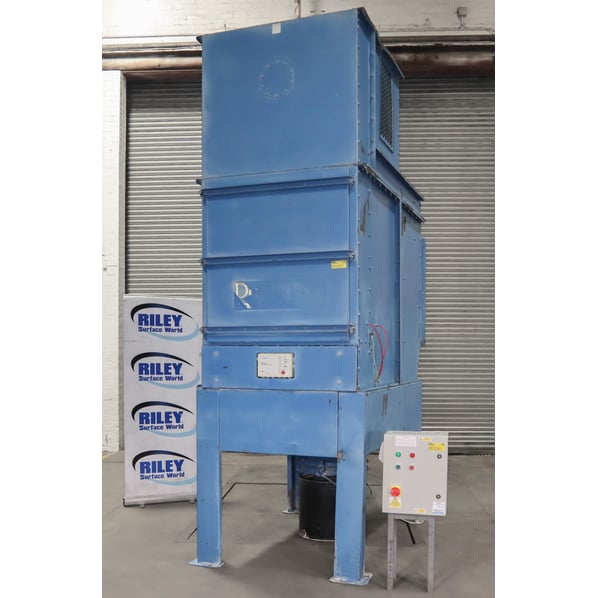


- Stock No
- EE2241
- Manufacturer
- Donaldson Torit (DCE)
- Model
- F2030BK11
- Year of Manufacture
- 2015
- Serial
- 00059540
- Condition
- From a working environment, Good Condition
- Approx Duty CFM / M³/Hr
- 2330 // 4000m2/Hr
- Filter Area ft² / m²
- 325 ft2 // 30m2 (20 Elements 1.5m each)
- Other Info
- ATEX compliant explosion panel
- Location
- Our Central Warehouse, Aldridge, UK
- Weight (kgs)
- 1293
- External Dimensions (WxDxH mm) [?]
- 2600 x 1300 x 3900
- Delivery Your delivery options
Description
The DCE2000 series is a self-contained dust control unit which combines proven filtration technology with innovative design and ease of use features.
One of the most versatile and user-friendly filters on the market today, its innovative design fits in well with modern factory environments. Its modular construction makes for easy installation and the automatic continuous reverse jet cleaning ensures that processing operations are uninterrupted.
Depending on the requirement, an option for either fabric (F) or sintered polymer Sintamatic (S) filtration media can be specified to handle almost any medium sized process dust problem.
Internal surfaces are smooth to prevent build-up of product, thus minimising infestation or contamination and as one would expect from a Torit DCE product there are many design features ensuring ease of maintenance
Performance & Reliability
- Continuous reverse jet cleaning ensuring no interruption to the production process.
- DCE “Downflow” air flow principle provides proven performance and reliability.
- IPC (Integrated Pulse Controller).
- Clean side element removal for easy element change-out with minimal dust contact.
- Enclosed controls and cleaning resulting in quiet operation and increased protection from damage for sensitive equipment.
- Low level access to controls for quick and easy maintenance.
- Explosion relief panel for use with ATEX rated dusts.
- Smooth internal surfaces minimise infestation and contamination.
- Self-contained aesthetically pleasing unit requires minimum floorspace and fits in with modern manufacturing plant design.
The DCE ‘F’ 2030 is the natural choice in any company’s manufacturing process, not only elimination nuisance dust but very importantly, having the ability to reclaim product. Its design is such that it naturally slots into the production process, making it an integral part of the whole operation.
Moreover, Torit DCE’s unrivalled expertise ensures product reliability second to none. The high efficiency fabric medium RN 487 utilised is designed to handle heavy dust burdens continuously at high filtration velocities.
Typical Applications
- Agrofood
- Cement
- Chemical
- Confectionery
- Food processing
- Gypsum
- Paint and dyestuffs
- Pharmaceutical
- Powder materials
- Rubber
- Tobacco And many more
Technical Specifications
- Filter area - 30m² (323 ft²)
- Fan size - 7.5kW
- Overall dimensions - 2600mm x 1300mm x 3900 mm
- Max inlet - 750mm x 196 mm (TBC)
Factors to Consider for Your Next Dust Extractor
When implementing the safety measures to ensure minimal risk to your workers, the factors to consider when purchasing your extraction unit/system are:
- Dust Source - Does the process that produces dust occur in an enclosed or open area?
- Capacity - Does the extractor have a large enough filter area required to handle the volume of dust?
- Type of Dust – Do you need an extractor capable of handling dust at risk of self-igniting?
- Maintenance – Would a self-cleaning extractor with an automatic shaker cycle be more suitable for you?
For further guidance, find out how to carry out your own COSHH (Control of Substances Hazardous to Health) risk assessment at the HSE website to help calculate your requirements.
Importance of Explosion Panels in a Dust Extractor
As extraction systems suck in air in concentrated volumes, the risk of explosive dust igniting is greater; therefore precautions are required to control the risk. A dust extractor with explosion panels installed will have these panels located in the areas where the dust is most likely to combust, controlling the explosion so it ignites in the area that has been constructed to withstand the impact without damaging the extractor itself.
Importance of Dust Extractors
Dust in the workplace can affect product quality and employee´s health. Having a dust-free environment is essential to the health and safety of the workforce. Not only does it affect the health of employees but the dust covers the equipment affecting production processes and quality of the products.
Capturing the dust at the source prevents it from spreading, done by using a dust extractor system to facilitate the important housekeeping to avoid it from accumulating.
What is Dry Dust Extraction?
The most popular dust extraction method, dry dust extractors collect dust using filters and cartridges. Known for processing large volumes of air when filtering medium/large dust particles such as wood, flour, and metals.
They typically include a cleaning system to discharge the dust gathered within the filters and cartridges, they carry out a shaker cycle or reverse pulse cycle to free the collected dust and empty it into a removable storage bin.
How do Dust Extractors Work?
Dust collection systems work in a variety of different ways but all have general principles in common. They draw process dust and particulates from the air through a filter that first captures and separates the matter, and then discharges decontaminated air back into the workplace or environment.
Dust extractors are used in many different and varied industries and so different demands are made of them; however all have common components such as a blower (or fan), dust filter, filter cleaning system, dust container and dust removal system.
Five common types of dust collection equipment are fabric filter baghouses, inertial separators (like mechanical cyclones), cartridge collectors, wet scrubbers, and electrostatic precipitators.
What are Reverse Pulse Jet Dust Collectors?
Reverse Pulse Jet Dust Collectors use a jet of air to clean dust from the collector's filters. Commonly used in pleated filter cartridge units, the filters are cleaned by a series of rapid, high-pressure air jets which sends a blast or shock of air through the reverse side of the filters. In effect this shakes the collected dust from the filters into the dust collection system. The rapid reverse pulse of air allows for continuous operation with the fan running and has high collection efficiencies.
Reverse Pulse Jet Dust Collectors are the most common type of industrial dust collectors and can handle a wide range of temperatures and pressures. They are commonly used in manufacturing environments where large volumes of solids are processed, such as mineral production, food processing and metal fabrication industries.
A control unit sets the variables such as time duration between pulses, length of pulse and pressure.
 Print / Download Donaldson Torit (DCE) F2030BK11 Dust Extractor Datasheet
Photographs taken prior refurbishment. Our refurbishment service is not available on all machines.
Machines & equipment for sale
- Surface Treatment
- Cleaning & Degreasing
- Polishing & Belt Linishing
- Mass Finishing
- Ovens & Furnaces
- Process Cooling
- Shot Blasting
- Dust & Fume Extraction
- Air Compressors
- Rectifiers & Transformers
- Miscellaneous
- Latest Stock
- Special Offers
- Direct From Site Clearances
- Auctions
- Brand New Machines
- Available Immediately
- Sell Your Machine
Machine Alert
Get the latest machines emailed directly to you as they become available to buy online. Sign Up Now
